
Headed Shear Connectors are welded fasteners used to create composite action between structural steel and concrete slabs. Installed using the ARC stud welding process, they transfer horizontal shear forces across the steel-to-concrete interface, allowing both materials to act together under load.
Used in composite floor systems, bridge decks, parking structures, and steel-framed buildings, headed stud shear connectors feature a forged head for concrete embedment and load transfer. Manufactured from low-carbon steel and installed with matching ferrules, they are designed for structural applications requiring reliable shear performance.
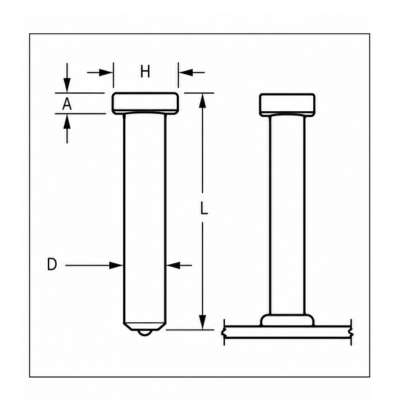
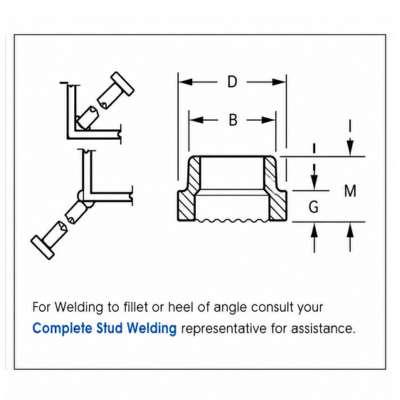
| Stud Specifications | Ferrule Specifications | |||||||
|---|---|---|---|---|---|---|---|---|
| D | H | A | No. | D | B | G | M | |
| 3/4 | 1-1/4 | 3/8 | F075-F | 1.218 | 1.03 | 0.469 | 0.656 | |
| 3/4 * | 1-1/4 | 3/8 | F075-TD | 1.335 | 1.21 | 0.406 | 0.6 | |
| 7/8 | 1-3/8 | 3/8 | F087-F | 1.406 | 1.21 | 0.545 | 0.732 | |
| 1 | 1-5/8 | 1/2 | F100-F | 1.610 | 1.406 | 0.632 | 0.82 | |
* For 3/4” weld thru-deck only
| Property | Type A | Type B |
|---|---|---|
| Tensile Strength | 61,000 psi min. | 65,000 psi min. |
| Yield Strength | 49,000 psi min. | 51,000 psi min. |
| Elongation (% in 2 in.) | 17% min. | 20% min. |
| Elongation (% in 5x dia.) | 14% min. | 15% min. |
| Reduction of Area | 50% min. | 50% min. |
Type A Studs: General purpose studs.
Type B Studs: Headed, bent, or of other configuration that are used as an essential component in composite beam design and construction.
| Stud Diameter | Chuck P/N | Ferrule Type | Ferrule P/N | Foot P/N | Grip P/N | Ferrule Foot Plate P/N (Dual Leg) |
|---|---|---|---|---|---|---|
| 3/4 | CH-075 | Flat | F075-F | B-2C | GC-075 | QN-075 |
| Low Profile | F075-LP | B-2C | GC-075 | QN-075 | ||
| Vertical | F075-V | B-2C | GC-075 | QN-075 | ||
| Inside Angle | F075-IA37 | B-2C | GD-075 | N/A | ||
| Inside Angle | F075-IA50 | B-2C | GD-075 | N/A | ||
| Outside Angle | F075-OA | B-2C | GC-075 | QN-075 | ||
| Weld Thru Deck (WTD) | F075-TD | B-0021 | B-0060-1 | N/A | ||
| 7/8 | CH-087 | Flat | F087-F | B-3C | GC-087 | QN-087 |
| Vertical | F087-V | B-3C | GC-087 | QN-087 | ||
| Outside Angle | F-087-OA | B-3C | GC-087 | QN-087 | ||
| Weld Thru Deck (WTD) | F087-TD | B-0021 | B-0060-4 | N/A | ||
| 1 inch | CH-100 | Flat | F100-F | B-3C | GC-100 | QN-100 |
| Flat | F100-F | B-0021 | B-0060-4 | QN-100 |
| Specifications | Packaging Detail | Weights – in pounds | ||||||
|---|---|---|---|---|---|---|---|---|
| Diameter (D) | Length (L) | CSW Part Number (mild steel) |
Pieces Per Box | Boxes Per Pallet | Pieces Per Pallet | Box Weight | Pallet Weight | 1,000 Pcs. Weight |
| Typical Bare Beam Sizes (3/4”) | ||||||||
| 3/4 | 3 – 3/16 | HSCM0750318 | 125 | 48 | 6,000 | 60 | 2,880 | 480 |
| 3 – 11/16 | HSCM0750368 | 100 | 48 | 4,800 | 55 | 2,640 | 550 | |
| 4 – 3/16 | HSCM0750418 | 100 | 48 | 4,800 | 63 | 3,024 | 630 | |
| 4 – 11/16 | HSCM0750468 | 75 | 27 | 2,025 | 51 | 1,377 | 680 | |
| 5 – 3/16 | HSCM0750518 | 60 | 48 | 2,880 | 43 | 2,064 | 717 | |
| 5 – 11/16 | HSCM0750568 | 60 | 48 | 2,880 | 47 | 2,256 | 783 | |
| 6 – 3/16 | HSCM0750618 | 60 | 48 | 2,880 | 51 | 2,448 | 850 | |
| 6 – 11/16 | HSCM0750668 | 80 | 27 | 2,160 | 75 | 2,025 | 938 | |
| 7 – 3/16 | HSCM0750718 | 60 | 27 | 1,620 | 59 | 1,593 | 983 | |
| 8 – 3/16 | HSCM0750818 | 50 | 27 | 1,350 | 56 | 1,512 | 1,120 | |
| 9 – 3/16 | HSCM0750918 | 100 | 9 | 900 | 123 | 1,107 | 1,230 | |
| 10 – 3/16 | HSCM0751018 | 100 | 9 | 900 | 137 | 1,233 | 1,370 | |
| 12 – 3/16 | HSCM0751218 | 1,100 | 1 | 1,100 | 1,760 | 1,760 | 1,600 | |
| 16 – 3/16 | HSCM0751618 | 1,000 | 1 | 1,000 | 2,000 | 2,000 | 2,000 | |
| For non standard sizes, please contact your Complete Stud Welding representative. | ||||||||
| Typical Weld Thru-Deck Sizes (3/4”) | ||||||||
| 3/4 | 3 – 3/8 | HSCM0750337 | 125 | 48 | 6,000 | 62 | 2,976 | 496 |
| 3 – 7/8 | HSCM0750387 | 100 | 48 | 4,800 | 58 | 2,784 | 580 | |
| 4 – 3/8 | HSCM0750437 | 100 | 48 | 4,800 | 62 | 2,976 | 620 | |
| 4 – 7/8 | HSCM0750487 | 75 | 48 | 3,600 | 51 | 2,448 | 680 | |
| 5 – 3/8 | HSCM0750537 | 60 | 48 | 2,880 | 45 | 2,160 | 750 | |
| 5 – 7/8 | HSCM0750587 | 60 | 48 | 2,880 | 49 | 2,352 | 817 | |
| 6 – 3/8 | HSCM0750637 | 60 | 48 | 2,880 | 53 | 2,544 | 883 | |
| For non standard sizes, please contact your Complete Stud Welding representative. | ||||||||
| Standard Sizes (7/8”) | ||||||||
| 7/8 | 3 – 3/16 | HSCM0870318 | 100 | 27 | 2,700 | 66 | 1,782 | 660 |
| 3 – 11/16 | HSCM0870368 | 100 | 27 | 2,700 | 74 | 1,998 | 740 | |
| 4 – 3/16 | HSCM0870418 | 100 | 27 | 2,700 | 80 | 2,160 | 800 | |
| 5 – 3/16 | HSCM0870518 | 75 | 27 | 2,025 | 73 | 1,971 | 973 | |
| 6 – 3/16 | HSCM0870618 | 50 | 27 | 1,350 | 57 | 1,539 | 1,140 | |
| 7 – 3/16 | HSCM0870718 | 45 | 27 | 1,215 | 59 | 1,593 | 1,311 | |
| 8 – 3/16 | HSCM0870818 | 40 | 27 | 1,080 | 59 | 1,593 | 1,475 | |
| 9 – 3/16 | HSCM0870918 | 75 | 9 | 675 | 125 | 1,125 | 1,667 | |
| 10 – 3/16 | HSCM0871018 | 75 | 9 | 675 | 135 | 1,215 | 1,800 | |
| 12 – 3/16 | HSCM0871218 | 825 | 1 | 825 | 1,793 | 1,793 | 2,173 | |
| Standard Sizes (1 inch) | ||||||||
| 1 inch | 3 – 1/4 | HSCM1000325 | 100 | 27 | 2,700 | 74 | 1,998 | 740 |
| 4 – 1/4 | HSCM1000425 | 100 | 27 | 2,700 | 80 | 2,160 | 800 | |
| 5 – 1/4 | HSCM1000525 | 75 | 27 | 2,025 | 73 | 1,971 | 973 | |
| 6 – 1/4 | HSCM1000625 | 50 | 27 | 1,350 | 57 | 1,539 | 1,140 | |
| 7 – 1/4 | HSCM1000725 | 45 | 27 | 1,215 | 59 | 1,593 | 1,311 | |
| 8 – 1/4 | HSCM1000825 | 40 | 27 | 1,080 | 59 | 1,593 | 1,475 | |
| 9 – 1/4 | HSCM1000925 | 75 | 9 | 675 | 125 | 1,125 | 1,667 | |
| 10 – 1/4 | HSCM1001025 | 50 | 9 | 950 | 125 | 1,125 | 2,500 | |
| 12 – 1/4 | HSCM1001225 | 600 | 1 | 6000 | 1760 | 1,760 | 2,934 | |
| For non standard sizes contact your Complete Stud Welding Representative. | ||||||||
Headed Shear Connectors are welded fasteners used to create composite action between structural steel and concrete slabs. Installed using the ARC stud welding process, they transfer horizontal shear forces across the steel-to-concrete interface, allowing both materials to act together under load.
Used in composite floor systems, bridge decks, parking structures, and steel-framed buildings, headed stud shear connectors feature a forged head for concrete embedment and load transfer. Manufactured from low-carbon steel and installed with matching ferrules, they are designed for structural applications requiring reliable shear performance.
Headed shear connectors are engineered to transfer longitudinal shear forces between structural steel and concrete. Their geometry, material composition, and weld configuration are designed specifically for composite construction systems requiring predictable load distribution and structural interaction.
The embedded portion of the connector engages the surrounding concrete, while the weld base secures the stud to the steel member. This configuration enables force transfer between dissimilar structural materials under service loading conditions.
The forged head increases resistance to separation forces within the concrete section. This geometry contributes to connector anchorage after concrete placement and curing.
The connector diameter and weld base are designed to create a complete fusion weld during installation. This weld interface forms the primary load path between the steel substrate and the connector body.
Headed shear connectors are utilized where horizontal shear forces must be transferred across the steel-concrete boundary. Their design supports composite beam and deck construction applications requiring coordinated material performance.
Dedicated ferrules are used during welding to contain the molten weld metal and control weld profile formation. This process assists in producing repeatable weld geometry across large connector installations.
These connectors are designed for use with ARC stud welding equipment, including automated and semi-automated systems utilized in structural fabrication environments and field-installed composite construction projects.
Get assistance selecting headed stud shear connectors for composite deck, beam, and structural steel applications. Our team can help identify the proper headed stud shear connectors for bridge, building, and composite deck applications.